Airborne transmission
Transmission of infectious diseases through small particles suspended in air.

Airborne transmission, also known as aerosol transmission, is the spread of infectious diseases through small particles suspended in the air. It is a critical concept in both human and veterinary medicine, involving pathogens such as viruses, bacteria, and fungi that can be released through breathing, talking, coughing, sneezing, and other activities that generate aerosols or droplets.
- field
- Infectious disease transmission
- known_for
- Transmission of diseases via aerosols and droplets suspended in air
- key_pathogens
- SARS-CoV-2, measles, chickenpox, tuberculosis, influenza, norovirus
- key_factors
- Temperature, relative humidity, ventilation, air conditioning
Lore & Background
Environmental factors such as temperature and relative humidity influence the efficacy of airborne disease transmission. Relative humidity plays an important role in droplet evaporation and travel distance; an ideal humidity for preventing aerosol respiratory viral transmission at room temperature appears to be between 40% and 60% RH. Poor ventilation enhances transmission by allowing aerosols to spread undisturbed in indoor spaces. The Wells-Riley model can be used to make simple estimates of infection probability.
Reader's Guide
Airborne transmission is a fundamental concept in understanding the spread of many significant infectious diseases, including SARS-CoV-2, measles, tuberculosis, and influenza. The recognition that exhaled particles form a continuum of sizes, rather than a strict cutoff between droplets and aerosols, has important implications for infection control. Prior to COVID-19, ventilation standards focused more on supplying oxygen than on disease-related air quality. The COVID-19 pandemic highlighted the importance of understanding airflow patterns, as maximizing ventilation is not always the most effective approach; a room can be well-prepared even at low air changes per hour. This insight could lead to safer building designs and energy savings during future pandemics. A layered risk-management approach—including mask wearing, hand hygiene, ventilation, air filtration, vaccination, testing, quarantine, and contact tracing—is recommended to slow transmission.
Did You Know?
- The traditional size cutoff of 5 μm between airborne and respiratory droplets has been discarded.
- Relative humidity between 40% and 60% is ideal for preventing aerosol respiratory viral transmission at room temperature.
- Poor ventilation enhances transmission by allowing aerosols to spread undisturbed in indoor spaces.
The Physics of Invisible Carriers
For decades, medical science drew a hard line at five micrometers, separating airborne particles from respiratory droplets and building hospital infection protocols around that boundary. Modern research has dismantled that binary. Exhaled particles form a continuous spectrum of sizes, and their ultimate fate depends not only on initial diameter but on the surrounding environmental conditions. Particles larger than one hundred micrometers typically settle within two meters of the person who emitted them, but anything smaller can linger in air currents for extended periods and drift considerably farther. A particularly consequential band sits around twenty micrometers: these particles initially ride the momentum of cough jets and HVAC airflow much like true aerosols, then gradually succumb to gravity at a greater distance, earning the nickname jet riders. Because this size range is also the one most efficiently trapped by nasal mucosa—the primary infection site identified in SARS-CoV-2—researchers suspect these mid-range particles played a significant role in propelling the pandemic forward. The earlier size-based error, it turns out, shaped clinical precautions for an entire generation.
A Spectrum of Invisible Threats
The organisms capable of riding aerosols into a new host span the entire microbial world. Viruses such as measles morbillivirus, the chickenpox agent, influenza, enterovirus, norovirus, adenovirus, and respiratory syncytial virus all feature on the list, alongside bacterial threats like Mycobacterium tuberculosis and various fungal species. In veterinary medicine the same principle applies: Newcastle disease, for instance, is an airborne avian infection that has affected domestic poultry across the globe. What makes the taxonomy especially tricky is that some pathogens are anisotropic—their mode of entry changes the disease they produce. Yersinia pestis, the bacterium behind plague, and Francisella tularensis, responsible for tularemia, can each trigger severe pneumonia when inhaled as airborne particles, a far different clinical picture from their other transmission routes. Researchers have proposed classifying airborne spread into three tiers: obligate, exemplified by tuberculosis, which transmits essentially only through aerosols; preferential, as with chickenpox, which can use other routes but favors aerosols; and opportunistic, as with influenza, which typically spreads by other means but can jump via aerosols under favorable conditions. Limited research exists to confirm how critical each category truly is.
The Role of Environment and Behavior
Whether an aerosolized pathogen reaches a susceptible person depends heavily on the physical environment. Temperature and relative humidity stand out as the most influential variables. A thirty-micrometer droplet can evaporate within seconds, and the CDC advises keeping indoor relative humidity at a minimum of forty percent to meaningfully reduce the infectivity of airborne virus. Research suggests the sweet spot for limiting respiratory viral spread at room temperature falls between forty and sixty percent humidity; below thirty-five percent, infectious virus persists in the air for longer. Beyond humidity, factors such as pH, salinity, wind speed, air pollution, and solar radiation all modulate how far and how long infectious particles remain viable. Human behavior compounds the risk. Poor ventilation allows aerosols to accumulate undisturbed in enclosed spaces, while crowded rooms raise the probability that an infected individual is present. The longer a susceptible person lingers in such an environment, the higher the transmission probability. Sneezes can project infectious droplets for ten or more meters, and activities as mundane as flushing toilets, spraying liquids, or raising dust can generate aerosol clouds. Because airborne transmission is inherently difficult to demonstrate with certainty, epidemiologists rely on the Wells-Riley model to produce straightforward estimates of infection probability.
From Inhalation to Infection
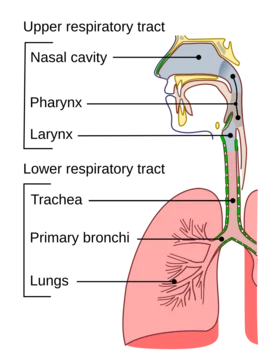
Once airborne pathogens are inhaled, they typically colonize the nose, throat, sinuses, and lungs. The initial assault on the respiratory system can produce familiar symptoms—sinus congestion, persistent coughing, sore throats—reflecting inflammation of the upper airway. From there, the infection may spread to other organ systems, turning a localized respiratory event into a systemic illness. The generation of these infectious particles is remarkably varied. Breathing, talking, coughing, and sneezing are the most obvious sources, but raising dust, spraying liquids, and even flushing toilets can create aerosol clouds that carry viable microbes. The source material itself can be bodily secretions from an infected individual or biological wastes. Air pollution adds another layer of vulnerability: pollutants worsen airway inflammation and impair lung function, potentially making the respiratory tract more receptive to incoming pathogens. It is worth noting that the amount of aerosol and droplet material produced varies enormously from person to person and from activity to activity, meaning no two exposure events are identical. This variability, combined with the difficulty of proving airborne transmission unequivocally in controlled settings, makes the field one of the most complex areas of infectious disease science.
Frequently Asked Questions
Who is Airborne transmission?
Airborne transmission is the mechanism by which infectious pathogens travel through tiny particles suspended in the air, reaching new hosts when those particles are inhaled. It is a core concept in both human and veterinary infectious-disease science, distinct from larger droplet spread because the particles can remain suspended for extended periods.
What are Airborne transmission's powers or role?
Its primary function is carrying viruses, bacteria, and fungi—such as measles, tuberculosis, SARS-CoV-2, and influenza—across a room via aerosols generated by breathing, talking, coughing, or sneezing. The efficiency of this spread is heavily shaped by temperature, relative humidity, ventilation rates, and air-conditioning design.
How does Airborne transmission's story end?
There is no single 'ending,' but its impact can be sharply reduced by improving ventilation, maintaining optimal indoor humidity, and deploying high-efficiency air filtration. In practice, public-health strategies combine these environmental controls with vaccination and masking to break the chain of aerosol-borne spread.
Why is Airborne transmission important?
It explains how diseases like chickenpox, measles, and tuberculosis can infect people who were never in direct contact with a sick individual, making it a central concern in hospital design and outbreak management. Understanding aerosol dynamics is essential for protecting healthcare workers and vulnerable populations in enclosed spaces.
What are Airborne transmission's key 'allies' (pathogens)?
The most notable pathogens that rely on this route include SARS-CoV-2, measles virus, varicella (chickenpox), Mycobacterium tuberculosis, influenza, and norovirus. Each exploits the aerosol pathway in slightly different ways, but all benefit from the ability to linger in air and travel well beyond the immediate vicinity of the infected person.
More in Respiratory & Infectious Diseases 1-24
Elsewhere in the Respiratory & Infectious Diseases universe
Spotted an error? Know more?
This is a living reference — every entry is fact-audited, and reader corrections feed straight into our audit queue. Suggest an edit · See this site's audit record