Bronchitis
Inflammation of the bronchi causing cough, often viral or smoking-related.

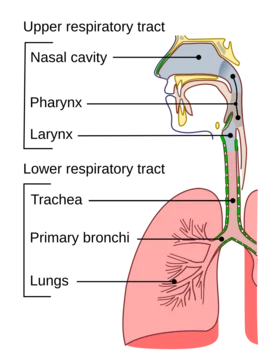
Bronchitis is inflammation of the bronchi (large and medium-sized airways) in the lungs that causes coughing. It usually begins as an infection in the nose, ears, throat, or sinuses, then makes its way down to the bronchi. Bronchitis can be acute or chronic, with acute bronchitis being one of the more common diseases.
- type
- Medical condition
- common_symptom
- Coughing up sputum, wheezing, shortness of breath, chest pain
- acute_cause
- Viral infection in more than 90% of cases
- chronic_cause
- Tobacco smoking is the most common cause
- acute_prevalence
- About 5% of adults and 6% of children have at least one episode a year
- chronic_prevalence_in_US_2018
- 9.3 million people diagnosed
Lore & Background
Acute bronchitis, also known as a chest cold, is a short-term inflammation typically caused by a viral infection such as rhinovirus, adenovirus, parainfluenza, or influenza. Symptoms include coughing up mucus, wheezing, shortness of breath, fever, and chest discomfort, with the cough lasting around three weeks. Risk factors include exposure to tobacco smoke, dust, and other air pollution. Treatment involves rest, paracetamol, and NSAIDs for fever; antibiotics are generally not used except for pertussis.
Reader's Guide
Chronic bronchitis is defined by a productive cough lasting three months or more per year for at least two years. It is often associated with chronic obstructive pulmonary disease (COPD), though most people with COPD do not have chronic bronchitis. Tobacco smoking is the most common cause, with air pollution and genetics playing smaller roles. Treatments include quitting smoking, vaccinations, rehabilitation, inhaled bronchodilators and steroids, and sometimes long-term oxygen therapy. Acute bronchitis is the most common type of bronchitis, while chronic bronchitis is less common, with 9.3 million people diagnosed in the United States in 2018.
Did You Know?
- In more than 90% of cases, acute bronchitis is caused by a viral infection.
- Chronic bronchitis is defined by a productive cough that lasts three months or more per year for at least two years.
- Tobacco smoking is the most common cause of chronic bronchitis.
- About 5% of adults and 6% of children have at least one episode of acute bronchitis each year.
Taxonomic Identity and Genetic Blueprint
Infectious bronchitis virus occupies a specific niche within the genus Gammacoronavirus, commonly referred to as group three, and carries a non-segmented, positive-sense single-stranded RNA genome. Its taxonomic pedigree is remarkable: IBV once served as the type species for the genus Igacovirus, and in an even earlier era—when all known coronaviruses were grouped under a single genus simply called Coronavirus—it functioned as the type species representing the entire coronavirus family. This foundational role highlights how central this avian pathogen was to the earliest days of coronavirus research. The virus is strictly avian in its host range and is the causative agent of avian infectious bronchitis, a disease that simultaneously targets the respiratory tract, the gut, the kidneys, and the reproductive system. Its economic reach is considerable, as it degrades the performance of both meat-type and egg-type chickens, inflicting substantial financial losses across the global poultry industry.
Multi-Organ Pathology and Clinical Consequences
After a bird inhales the virus, IBV binds to glycoprotein receptors that carry sialic acid on the ciliated epithelial cells of the respiratory lining. The local replication cycle then strips cilia of their motility, provokes mucus overproduction, and triggers necrosis and cellular shedding, a cascade that manifests clinically as labored breathing, abnormal lung sounds, and asphyxia. Crucially, this respiratory replication seeds a viremia that transports the virus to distant organs. Highly virulent nephrotropic strains can colonize the epithelium of renal tubules and nephrons, ultimately precipitating kidney failure; grossly, the affected kidneys appear swollen and pale, with urate deposits visible in the ureters. In laying hens, viremic spread reaches the oviduct, where it damages both the magnum and the uterus. The result is a dramatic drop in egg output, shell-less or brittle eggs, and watery albumen. If a bird is infected during puberty, the developing oviduct is permanently disrupted, producing so-called false layers that can never resume normal laying.
Recombination as an Engine of Genetic Diversity
A particularly important facet of IBV biology is its propensity for recombination. When a single bird harbors two distinct IBV strains at the same time, the viral genomes can undergo recombination during the replication cycle, effectively swapping segments of genetic material. This molecular shuffling is not merely a laboratory curiosity; it appears to be a principal mechanism behind the wide genetic variation seen in IBV populations circulating in the wild. The practical implication is profound: the viral landscape is in constant flux, generating novel strain combinations that may differ in virulence, tissue tropism, or the ability to evade host immunity. This ongoing genetic reshuffling complicates epidemiological surveillance and places relentless pressure on the poultry sector to monitor and respond to emerging variants. In essence, recombination sits at the core of IBV's evolutionary strategy, ensuring the virus remains a persistent and adaptable threat to avian health worldwide.
Vaccination Strategies and the Immune Challenge
Both attenuated live vaccines and inactivated killed vaccines are currently available to protect poultry from IBV, yet their field effectiveness is constrained by poor cross-protection across the many circulating strains. The precise architecture of the protective immune response remains only partially elucidated, although researchers have identified the surface spike protein—specifically its amino-terminal S1 subunit—as sufficient on its own to induce robust protective immunity. This insight has catalyzed a new generation of vaccine designs. Experimental vector-based IB vaccines and genetically engineered IBVs that carry heterologous spike protein genes have yielded promising results in preclinical evaluations. In ovo vaccination, in which embryos are immunized before hatching, represents another active area of investigation. The overarching challenge remains matching vaccine-induced protection to the ever-shifting genetic mosaic of IBV, a problem that continues to drive innovation in veterinary virology.
Frequently Asked Questions
Who is Bronchitis?
Bronchitis is a medical condition defined by inflammation of the bronchi, the large and medium-sized airways inside the lungs. It presents in two major forms—acute and chronic—and is most recognizable for the persistent cough it triggers.
What are Bronchitis's powers/role?
Its signature effects include coughing up sputum, wheezing, shortness of breath, and chest discomfort. The condition typically starts as an infection in the nose, ears, throat, or sinuses before migrating downward into the bronchial passages.
How does Bronchitis's story end?
Acute episodes generally resolve on their own within a few weeks once the body clears the underlying viral trigger. Chronic bronchitis follows a much longer narrative arc and is most commonly sustained by prolonged tobacco smoking.
Why is Bronchitis important?
It is one of the most frequently encountered respiratory conditions, with roughly 5% of adults and 6% of children logging at least one episode each year. In the United States, an estimated 9.3 million people carried a chronic bronchitis diagnosis as of 2018.
What's the origin story behind Bronchitis?
In more than 90% of acute cases, a viral infection serves as the inciting event that kicks off the inflammatory cascade in the airways. For the chronic variant, sustained tobacco smoking stands out as the single most common driving factor.
More in Respiratory & Infectious Diseases 1-24
Elsewhere in the Respiratory & Infectious Diseases universe
Spotted an error? Know more?
This is a living reference — every entry is fact-audited, and reader corrections feed straight into our audit queue. Suggest an edit · See this site's audit record